Slow and steady wins the race – at least, that’s the theory.
Florida Gymnastics got off to a slower start than usual this year, leading some detractors to wonder if they might even end up in the afternoon session of this weekend’s SEC Championship meet – a fate reserved for the four bottom-ranked teams in the conference.
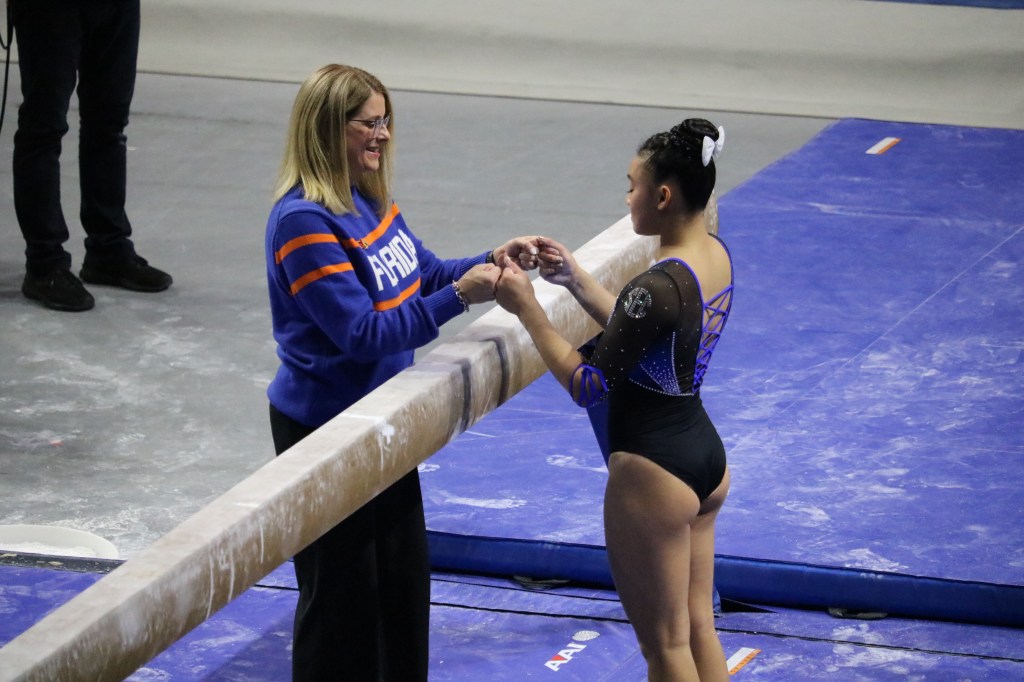
But as the weeks went on, the Gators pushed forward, improving on their score week after week for seven straight weeks. Head coach Jenny Rowland said that this team has really pushed themselves, always returning to the gym wanting to do more. “To see the evolution of this team that’s come from day one to now – it’s probably been the most change, the most improvement from day one that I’ve seen from any team.”
But it’s not just the team that’s standing out that way – the staff has approached the season a little differently as well. In scheduling competitions for this season, Rowland and co. made sure to have plenty of opportunities to practice the new format for quad meets that will feature in postseason to make them more palatable for a broadcast – two events going simultaneously, with vault and bars alternating and beam and floor alternating. The Gators kicked off their season with a quad and closed the season with two in a row, and also participated in one in the middle. Rowland said, “There are certain things that we’ve learned that we’re going to be mindful of -” as they approached the final regular season meet last week – “to be able to continue and learn and grow from for postseason.” Little things like not having teammates to cheer for them in each corner of the floor or give them a pep talk right before stepping on the apparatus, simply because all athletes must stay in the team corral during quad meets, are important to practice because gymnastics is such a mental game.
They also put a podium meet on the schedule – February’s Mizzou to the Lou quad meet – to ensure that the Gators had an opportunity to practice the different feel and movement of a raised competition floor and air underneath the apparatus. Gymnasts often use atmospheric guides – a signboard, a flag, a staircase, or even a teammate – for spotting while they are turning or flipping in the air, so suddenly being six feet taller changes where those guides are in their sightline and may change where they need to look altogether.
The coaches also adjusted lineups a lot more this season. In the past, Florida has had a few key all-arounders and has other athletes fill in the gaps as they best fit, but in more recent years, things have fluctuated a bit more. This year’s lineups have fluctuated perhaps the most, with every healthy athlete except one competing at least two routines – that’s 14 athletes total with multiple competitive outings. The last time Florida had that many athletes compete multiple routines in a single season was 2011, prior to Rowland’s hiring or any of the team’s national titles, so clearly, they’re doing something different. The freshmen have played a huge part in that, contributing 46% of competitive routines at their highest level this season, which was at the Nebraska quad meet two weeks ago. The pacing this season had to adjust for the huge role those new athletes needed to play on this team, and clearly it has. In Rowland’s view, the most important part of the pacing has been reps, making sure each of the freshmen has had plenty of opportunities to compete and find their footing in a college setting. “The more you compete, I feel like the better you’re going to get – the more confidence you gain, the stronger you get.”
Rowland believes that everything the team has done – from the meets they’ve chosen to the breadth of competitive roster and everything in between – has prepared the Gators for postseason even better than last year. “Them being able to adapt and adjust every week helps in postseason for what a rollercoaster that will look like.”
The First Challenge
Now that regular season is over, the Gators enter postseason tomorrow in the first of several major tests – the SEC Championship. They’ll enter as the second seed behind stalwart rival LSU, just ahead of Kentucky and Alabama, who round out the evening session. Earlier in the day, Arkansas, Missouri, Auburn, and Georgia will face off, but it’s very unlikely any of them will post a high-enough score to threaten the second session.
As usual, LSU’s strongest event is floor, followed by vault, bars, and then beam. The Tigers will start on vault and finish on floor – perhaps the strongest rotation order they could have hoped for – so Florida will have to be on top of their game to come out with a win. The names to watch for the Tigers are much the same as they’ve been for several years, if you’re familiar – Haleigh Bryant, Kiya Johnson, and Aleah Finnegan in the all-around – but they also have some new freshmen and a familiar transfer that you’ll want to keep an eye on as well. Amari Drayton and Konnor McClain each have opposite specialties – vault/floor and bars/beam, respectively – and are just as capable of high scores as any upperclassmen. McClain has already scored a 10.0 on both of her events! Former Gator Savannah Schoenherr is also part of their top six on vault and bars, as she once was for Florida, so don’t get confused seeing her in a purple leo!
Kentucky has had a record-breaking season, although beating the program record in its meet against Florida still wasn’t enough to best the Gators. Still, the Cats should 100% be considered not just threats to Florida, but title threats – they’re hungry for their first championship ring. Vault and floor are tied for their best events, followed by beam, then bars. They’ve chosen to start on bars and finish on vault, getting their worst out of the way and closing out on their best – typically a sound strategy. Of course, the number one Wildcat to watch is AA phenom Raena Worley, but also keep an eye on vaulter Makenzie Wilson, who earned Kentucky’s first pair of 10.0s in 25 years in conjunction with Worley. Seniors Bailey Bunn (UB/BB), Arianna Patterson (VT/BB), and Isabella Magnelli (VT/BB) are also capable of strong performances on their respective events, and freshman Creslyn Brose is near unstoppable on floor.
Alabama is the only team that beat Florida this season, so they also cannot be underestimated in this meet. Bars is the Tide’s best event, followed by beam, vault, and finally floor. Unfortunately, as the last seed in the night session, they didn’t get a choice about their rotation order – they’ll be starting on floor and ending on beam. Star all-arounders to watch include super-senior Luisa Blanco and junior Lilly Hudson, and you also won’t want to miss Chloe LaCoursiere on vault and bars, Makarri Doggette on bars, Shania Adams on bars and beam, and Ella Burgess on beam and floor. Though floor is the Tide’s worst event, if Jamison Sears is in the lineup, they may have an easier time – the freshman spitfire’s routine is an absolute highlight of any meet she’s in.
The Path to Victory
If this is the year Florida wins its next national title, the road doesn’t necessitate a win in Baton Rouge this weekend… but it feels like now is the time to start asserting dominance and putting the pieces together. We’ve seen some solid performances from the Gators this year, but a complete meet? 24 for 24? Not so much. It’s got to all come together at exactly the right time. The closest they’ve come was at Mizzou to the Lou, so if podium is what it takes, then maybe this weekend is, in fact, when it all comes together.
The Gators opted to start on beam, tied for their best event with vault, and will thus end on bars, their weakest event. The goal, then, must be to have a significant lead going into the final rotation. The hope will also be that everyone is well and all the yips are out on bars, such that the squad will put up a well-above-average number and win the day. Here’s a few key things to look out for each event, starting in the Gators’ planned rotation order.
BEAM
Confidence, confidence, confidence. This team can put together an absolutely killer rotation when everyone is feeling good and confident, and hopefully, by getting beam out of the way immediately, the Gators can keep their confidence from being in their bubble prior to the meet and carry it into the first rotation. They’ll also want to be sticking their landings, which has been a little elusive the past two weeks as newer players have rotated into the lineup.
FLOOR
High performance quality, precision, and keeping their cool will all be key to upping the ante on floor for postseason. Keeping the adrenaline under control is the only item in that list we haven’t discussed yet this season, and that’s because it’s key to a performance on podium. If the athletes get too amped up, they may overdo their tumbling, get a little bouncy on their landings, or even go out of bounds. They’ll want to try and stay as normal as possible to mitigate the podium’s inherent extra bounce.
VAULT
Landings. It’s all about the landings, or at least that’s what judges have largely demonstrated this season based on their scores. Florida is finally fielding a full lineup of 10.0 start-value vaults, so it has more upside than most of its competitors. Each of the other teams in the session has at least one Yurchenko full in the lineup, so advantage Florida in that regard. However, if they can’t land cleanly, the Gators would be better off with clean fulls. A few athletes have sat their vaults this season, and while that should theoretically be less of a concern with the extra oomph from the podium, balancing the podium spring with adjusting the power of their block will be a delicate game to play. Hopefully, podium training today and warmups tomorrow will be enough time for all six to figure out how to dial it in just right.
BARS
At this point, six hits would be great. Six hits would give Florida the opportunity to drop a 9.8 or a 9.85 and rack up a bars score over 49.5, a mark they’ve only surpassed once this season. Stuck landings, hit handstands, and hitting their low bar pirouettes will be key to that, and hopefully we won’t see a repeat of NCAA Semifinals 2022 where the bars weren’t fully secured beneath the podium. If the Gators end up with three scores of 9.9 or better and they’re ahead going into bars, I’ll feel okay – if it’s four or more, I’ll be thrilled.
Looking Ahead
Even still, SEC Championships are not the end-all be-all; Rowland and this Gator team have their eyes on the prize: the national title. Everything they do (and don’t do) at this meet can be used as a learning experience for the remainder of season.
Regionals will be a challenge, but as a top-ranked host team, Florida is favored to advance. Seeding isn’t set yet, but if competition were to happen this weekend, the Gators would face Utah, UCLA, and Mizzou, as well as several other lower-ranked, regionally-distributed teams – likely Georgia, Clemson, and several others on the East Coast. Any mistakes this weekend at SECs will demonstrate what puzzle pieces are still missing for those two meets – the Second Round and the Regional Final.
NCAA Nationals is where things get sticky. Eight teams compete, four teams advance to the final, but there are far more than four finals-caliber teams this year. Florida will have to put their best two meets of the season together back-to-back in order to both qualify and have even a chance at the national title. Oklahoma, who the Gators have not faced yet this year, has casually hit one of the best seasons in sport history, with a massive NQS of 198.475. The Sooners only have three meets below 198, whereas 198 has been a goal score for most other teams this season. Even if Florida has its best day, Oklahoma could still win.
It’s an uphill battle, but no one ever said gymnastics was easy. In the immortal words of Rowland, “pressure is a privilege,” and these Gators thrive in it. But will it be enough?


Leave a comment